Venerable Xenia of Rome, and her two female servants
Saint Xenia of Rome, in the world Eusebia, was the only daughter of an eminent Roman senator. From her youth she loved God, and wished to avoid the marriage arranged for her. She secretly left her parental home with two servants devoted to her, and set sail upon a ship. Through the Providence of…
Read the Life
Troparion & Kontakion
Saint Gerasimus, Bishop of Perm
Saint Gerasimos (Gerásimos), Bishop of Great Perm and Ust-Vymsk, was the third Bishop of the newly-enlightened Zyryani people, and a worthy successor to Saint Stephen, the Enlightener of Perm (April 26). He was elevated to the See of Perm after 1416. Although he lived far from the capital city,…
Read the Life
Troparion & Kontakion
Martyr John of Kazan
The Martyr John of Kazan suffered for Christ in the city of Kazan on January 24, 1529. During the reign of Great Prince Basil the Tatars swooped down upon Nizhni Novgorod. Many of the inhabitants were taken into captivity and brought to Kazan. Also among their number was the fearless John. When…
Read the Life
Troparion & Kontakion
Martyr Babylas of Sicily, and his two disciples: Timothy and Agapius
The Holy Martyrs Babylas of Sicily and his two disciples Timothy and Agapius lived during the third century on the outskirts of Rome. Saint Babylas was born in the city of Reupolium into a rich family, and he was raised by his parents in the Christian Faith. While still in his youth he abandoned…
Read the Life
Troparion & Kontakion
Saint Macedonius the Hermit of Syria
Saint Macedonius, a Syrian hermit, lived during the end of the fourth century and the beginning of the fifth. When he first embarked upon the path of asceticism, he led the life of a wanderer, roaming through the cities of Phoenicia, Cilicia, and Syria. Afterward, he spent forty-five years in the…
Read the Life
Troparion & Kontakion
Uncovering of the relics of Saint Anastasios the Persian
The uncovering of the relics of Saint Anastasios of Persia (January 22) took place in 638, ten years after his martyrdom. There are three traditions regarding his relics. According to the first, which is also accepted by the English historian Saint Bede (May 27), the relics were transferred to…
Read the Life
Venerable Dionysius of Olympus
Saint Dionysius of Olympus was born into a family of poor parents in the village of Platina. When he was an infant, the Cross shone over his crib. Fond of prayer and reading spiritual books from his youth, Saint Dionysius decided to become a monk after the death of his parents. With this aim he…
Read the Life
Troparion & Kontakion
Venerable Philotheus, founder of Philotheou Monastery, Mount Athos
Saint Philotheus, the founder of the Philotheou Monastery on Mount Athos, lived toward the end of the tenth century.
Read the Life
Troparion & Kontakion
Blessed Xenia of St. Petersburg
Saint Xenia lived during the eighteenth century, but little is known of her life or of her family. She passed most of her life in Petersburg during the reigns of the empresses Elizabeth and Catherine II. Xenia Grigorievna Petrova was the wife of an army officer, Major Andrew Petrov. After the…
Read the Life
Troparion & Kontakion
Martyrs Theodotion, Paul, and Pausirios
The Holy Martyrs and brothers according to the flesh Pausirius, Paul, and Theodotion lived in Egypt during the third century. Pausirius and Paul confessed their faith in Christ and suffered martyrdom under Diocletian (284-305). Theodotion converted to Christianity after witnessing their martyrdom.…
Read the Life
Troparion & Kontakion
Saint Philon, Bishop of Kolpasteia, Crete
Saint Philon, Bishop of Kolpasteia (Crete) He died peacefully in the fifth century. He wrote a commentary on the Pentateuch, and on the Song of Songs.
Read the Life
Troparion & Kontakion
Hieromartyr Philippicus and Martyr Barsimos
The Hieromartyr Philippicus the Presbyter and the Martyr Barsimos and two brothers were beheaded for their confession of faith in Christ.
The 18th-century 'fool for Christ' who lived in radical poverty and simplicity. Celebrated on January 24th, Xenia gave away her possessions after her husband's death and lived as a holy fool, helping others while appearing mad to the world. She represents the path of voluntary poverty and the wisdom hidden in apparent foolishness.
Vespers
The evening prayer service of the Orthodox Church, traditionally celebrated at sunset. Vespers includes psalms, hymns, scripture readings, and incense. On Saturday evenings, Great Vespers is often combined with the Sunday Divine Liturgy. The service marks the end of the liturgical day and prepares the faithful for rest and reflection.
Divine Liturgy
The central worship service of the Orthodox Church, celebrating the Eucharist (Holy Communion). Usually celebrated on Sundays and feast days, the Divine Liturgy consists of the Liturgy of the Word (scripture readings) and Liturgy of the Faithful (Eucharistic prayer and communion). The most common forms are the Liturgies of St. John Chrysostom and St. Basil the Great.
Matins (Orthros)
The morning prayer service of the Orthodox Church, traditionally celebrated at dawn. Also called Orthros in Greek tradition, this service includes the reading of the Gospel, the Great Doxology, and numerous psalms and hymns. Matins prepares the faithful for the day and is often celebrated immediately before the Divine Liturgy on Sundays and feast days.
Three Holy Hierarchs
The joint celebration of Saints Basil the Great, Gregory the Theologian, and John Chrysostom on January 30th. These three great Church Fathers and theologians were honored together to end disputes over which was greatest. They represent the unity of Orthodox theology, liturgy, and pastoral care. This feast is especially important in Orthodox education.
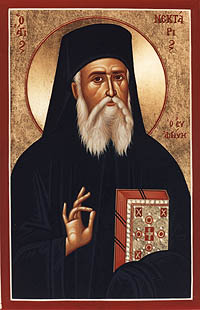
St. Nektarios, help us find the Path to Happiness
“A Christian must be courteous to all. His words and deeds should breath with the grace of the Holy Spirit, which abides in his soul, so that in this way he might glorify the name of God. He who regulates all of his speech also regulates all of his actions. He who keeps watch over the words he is about say also keeps watch over the deeds he intends to do, and he never goes out of the bounds good and benevolent conduct. The graceful speech of a Christian is characterized by delicateness and politeness. This fact, born of love, produces peace and joy. On the other hand, boorishness gives birth to hatred, enmity, affliction, competitiveness, disorder and wars.”
“How mistaken are those people who seek happiness outside of themselves, in foreign lands and journeys, in riches and glory, in great possessions and pleasures, in diversions and vain things, which have a bitter end! In the same thing to construct the tower of happiness outside of ourselves as it is to build a house in a place that is consistently shaken by earthquakes. Happiness is found within ourselves, and blessed is the man who has understood this. Happiness is a pure heart, for such a heart becomes the throne of God. Thus says Christ of those who have pure hearts: “I will visit them, and will walk in them, and I will be a God to them, and they will be my people.” (II Cor. 6:16) What can be lacking to them? Nothing, nothing at all! For they have the greatest good in their hearts: God Himself!” - St. Nektarios of Aegina, The Path to Happiness
Dear friends: When you shop at AmazonSmile, Amazon donates 0.5% of the purchase price to Christ The Savior Orthodox Church at no cost to you. Bookmark the link AmazonSmiles and support us every time you shop. Thank you!
Christ The Savior Orthodox Church 1070 Roxbury Road Southbury CT 06488